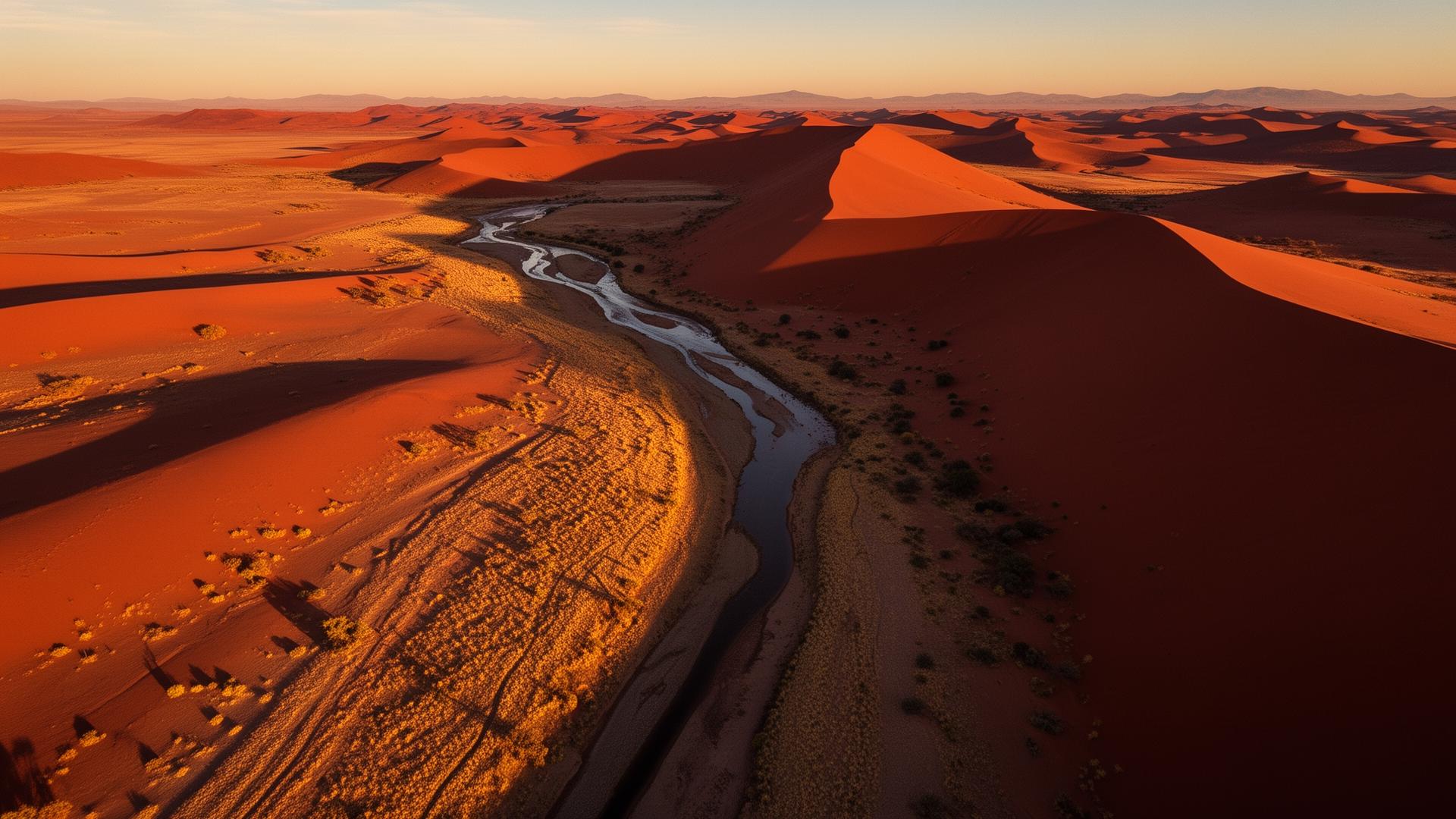

Most first-time Namibia trips go north — Sossusvlei, Swakopmund, Damaraland, Etosha. The southern loop is the version that goes the other way: Sossusvlei, NamibRand, Lüderitz, Kolmanskop, Fish River, the Quiver Tree forest, back. It's quieter, drier, more cinematic, and consistently the route returning visitors and photographers tell us they wish they'd done first.
On this page7What the southern loop is — and isn't · Who it suits — and who it doesn't …
What the southern loop is — and isn't
The southern loop covers everything south and west of Sossusvlei: the Sesriem and NamibRand desert, the abandoned Kolmanskop diamond town, the German colonial port of Lüderitz, the Fish River Canyon, the Quiver Tree forest at Keetmanshoop, and the central Kalahari edge on the way back to Windhoek. It's roughly 2,800 km of mostly tar with key gravel sections (D707, C13, the Fish River rim road).
It is not a wildlife route. There is no Etosha, no Caprivi, no Damaraland desert elephants. There are oryx, springbok, mountain zebra, occasional cheetah on the private reserves, and the bird life along the southern coast — but if 'I want to see a lion' is on your list, this isn't the right trip shape. The wildlife-deep loop and the southern loop are different routes.
Quick check
Is this you?
Who it suits — and who it doesn't
Returning Namibia travellers who already did Etosha and Damaraland on trip one. Photographers who want light, scale, abandoned architecture and quiet roads. Solo female travellers who consistently report the southern loop as their favourite shape (well-trafficked tar, calm lodges, strong communal-table culture, no remote-track exposure). Couples on a slow honeymoon who want the &Beyond / Wolwedans NamibRand experience. Travellers who specifically want the German colonial layer of Namibia — Lüderitz delivers it more honestly than Swakopmund.
It doesn't suit families with under-tens (the Kolmanskop and Fish River days are long and adult-paced), or first-time-Africa travellers whose mental image of the trip is built around game drives. For both groups, the classic northern loop is the right answer.
The 12-night shape
Arrival night Windhoek. Two nights Sossusvlei (Sesriem-area lodge, Deadvlei sunrise on day three). Two nights NamibRand (Wolwedans, Kwessi Dunes, or &Beyond Sossusvlei Desert Lodge — the southern desert at its most cinematic). One transfer night at Aus or Klein Aus Vista. Two nights Lüderitz (Kolmanskop on day one, the Bogenfels coast or a peninsula drive on day two). One night Canyon Roadhouse or Fish River Lodge inbound. Two nights at the Fish River rim (sunrise and sunset both worth the drive). One night at the Quiver Tree forest near Keetmanshoop. Final night back near Windhoek.
The lodge spacing matters. Lüderitz at one night reads as a half-day stop and you miss the Kolmanskop sunrise light, which is the whole reason to be there. Fish River at one night gives you neither the sunrise nor the sunset over the canyon — the two photographs you came for. NamibRand at one night gives you the dunes once and a single sundowner; the second night is when the place earns its premium.
- Night 1: Windhoek arrival
- Nights 2–3: Sossusvlei (Sesriem)
- Nights 4–5: NamibRand
- Night 6: Aus / Klein Aus Vista
- Nights 7–8: Lüderitz
- Night 9: Canyon Roadhouse
- Nights 10–11: Fish River rim
- Night 12: Quiver Tree forest
Kolmanskop: the photograph and the visit
Kolmanskop is one of the easiest 'great photographs' in Namibia — sand-filled rooms of an abandoned German diamond town, the morning light coming through the broken windows, no extra effort required. The catch is that the standard tourist permit only allows you in after 09:30, by which time the morning light is gone. The photographer's permit (around N$370 per person, available in advance from Ghost Town Tours) lets you in from sunrise. If you've come this far for the photograph, buy the permit. If you haven't, the standard permit is genuinely fine and Kolmanskop still delivers.
Plan the morning around it. From Lüderitz it's a 12-minute drive. Sunrise photographer's permit, two hours inside, breakfast in Lüderitz at 09:00, the rest of the day on the peninsula or the Bogenfels road if you've pre-arranged the permit (it's a separate reserve permit from the diamond company's office in Lüderitz).
Fish River Canyon: the two-night version
The drive to Fish River from Lüderitz is around 5 hours; from Windhoek it's 7. Both are long. Two nights on the rim is what makes the drive pay back — one for the sunset photograph at Hobas viewpoint, one for the sunrise photograph at the main viewpoint. Anything shorter is a long day's drive for a single afternoon view, which is the trip-report version where people come back saying 'Fish River was nice but not worth it'. They were right about their version.
The hike option (the 5-day descent to Ai-Ais) is a different trip and is permit-only, May–September only, with a medical certificate required. We plan that as a standalone, not as a slot in this loop.
NamibRand and Wolwedans: the part returning travellers come back for
NamibRand Nature Reserve, just south of the main Sossusvlei area, is a 200,000-hectare private reserve with the lowest light pollution in Africa (Dark Sky reserve gold tier). The lodges inside it — Wolwedans Dune Lodge, Wolwedans Boulders Camp, &Beyond Sossusvlei Desert Lodge, Kwessi Dunes — are some of the best desert lodges in southern Africa.
Two nights gives you a sunrise dune walk, a sundowner on a different dune, the night sky photography, and the slow-pace day in between. One night gives you arrival, dinner, departure. The premium is real (N$12,000–28,000 per couple per night depending on the lodge). It buys the strongest single experience on the southern loop — the one returning travellers ask us to repeat first.
Where the southern loop quietly breaks
Adding Etosha to make it 'feel more Namibian'. This adds two transfer days through ground that's a long way from the loop, and gives you an inferior version of both routes. If wildlife is required, plan the wildlife-deep route as a separate trip.
Driving the C13 from Aus to Lüderitz at the wrong time of day. The wild horses south of Aus are a worthwhile 30-minute stop, but the C13 funnels coastal fog from late morning. Aim to be in Lüderitz by 13:00.
Booking Wolwedans for one night to 'try the experience'. The lodge is two-night-minimum during peak season anyway, and the one-night version misses the slow desert day that is the entire point.
Final verdict
The southern loop is one of the most consistently rewarding shapes in Namibia, and one of the most under-recommended by generic itinerary builders. It rewards travellers who want landscape over wildlife, slow over busy, and cinematic over comprehensive. We plan this version with the lodge bookings, the Kolmanskop permits, the NamibRand minimum-night rules and the Fish River rim allocation built in.
Kian, Inside Namibia· Based in Swakopmund · desert specialist
I live in Swakopmund and spend most of my time in the desert — I know its dunes, its silences, and most of the snakes you'd rather not meet. My favourite stretches are the loneliness of Damaraland and the birding in Caprivi, and that's the lens I bring to every route I review.