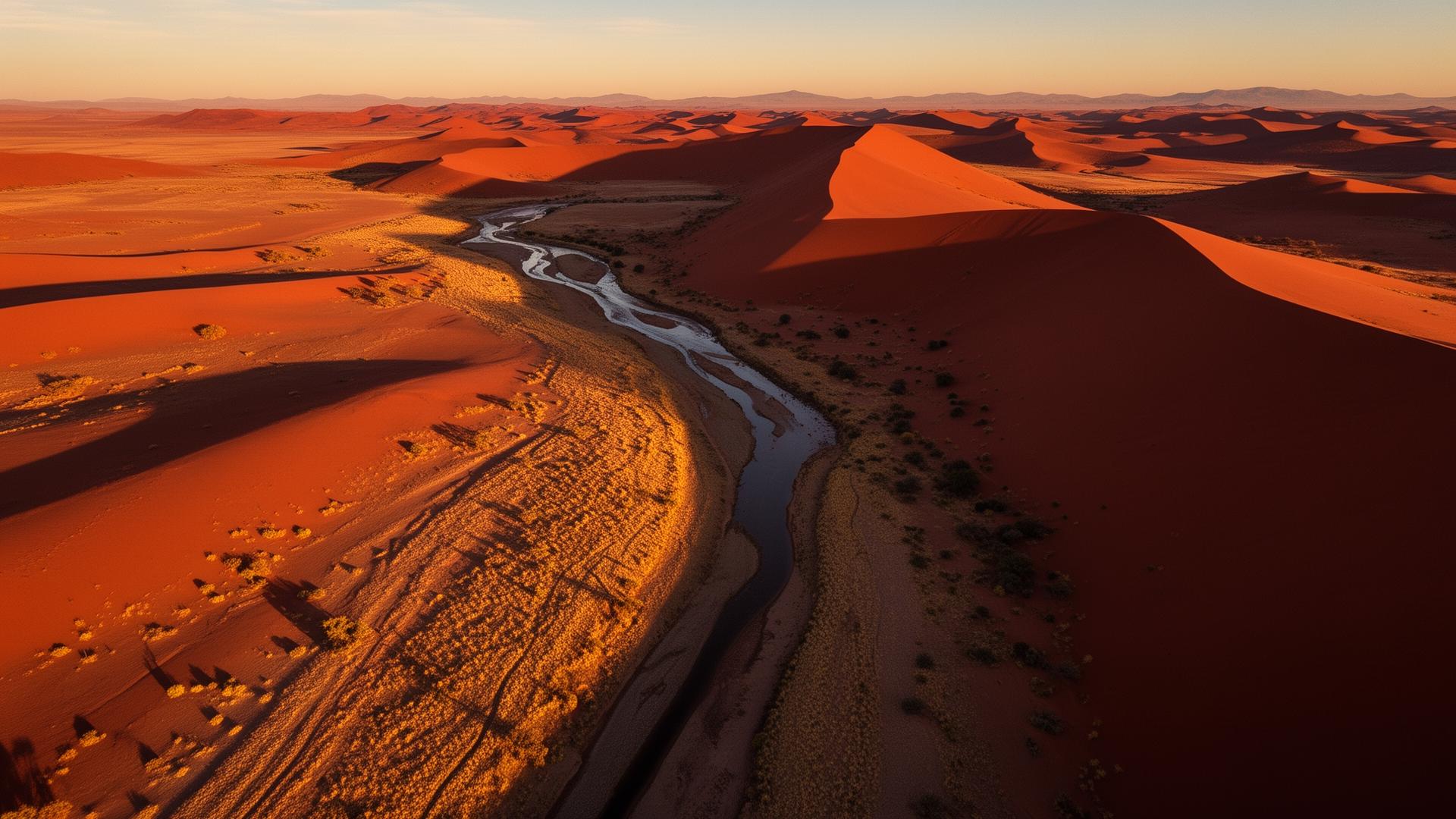

January and February in Namibia get a bad reputation for good reasons — the Sesriem road floods, the Sossusvlei access can close for days, the heat in the north is genuinely hard work, and lodge availability is patchy because half the staff are on leave. None of that means you can't have a brilliant Namibia trip in the green season. It means the shape has to be different. This is the route we plan when someone arrives with January–February locked in.
On this page6Why the standard Namibia route falls apart Jan–Feb · The shape that works: a southern green-season loop …
Why the standard Namibia route falls apart Jan–Feb
The Sesriem area receives most of its annual rain in January and February. The C19 and the access road into Sossusvlei flood after a single heavy storm, sometimes for 24–72 hours, occasionally for longer. Deadvlei becomes inaccessible from the C19 side (helicopter flights from Sesriem still run, but at premium rates). The northern routes — Damaraland, Kaokoland, the Caprivi — face the same wet-season access problems plus genuinely punishing daytime heat (38–42°C in the dry north, higher humidity in the strip).
We have a separate article on Sossusvlei road flooding that goes deeper on the access mechanics. The short version: if your route depends on Deadvlei access on a specific morning, the green season is the wrong month to lock it in.
Quick check
Is this you?
The shape that works: a southern green-season loop
The route that holds up in Jan–Feb runs Windhoek → Kalahari (Bagatelle / Kalahari Anib) → Quiver Tree forest at Keetmanshoop → optional Fish River viewpoint → NamibRand (south of the flooded Sesriem zone, on tar / good gravel) → Naukluft mountains → back to Windhoek. Five to seven nights. No Etosha, no Damaraland, no northern push.
This works for three structural reasons. First, the Kalahari is at its most photogenic in the green season — red sand, bright green grass after rain, dramatic afternoon thunderstorms. Second, the Quiver Tree forest with thunderstorm cells in the background is one of the strongest landscape photography opportunities Namibia offers, and it only happens in this window. Third, NamibRand sits south of the worst of the Sesriem flooding zone and the access road from the south (D826 / D827) typically stays drivable.
- Night 1: Windhoek arrival
- Nights 2–3: Kalahari (Bagatelle, Kalahari Anib, or Intu Afrika)
- Night 4: Quiver Tree forest near Keetmanshoop
- Nights 5–6: NamibRand (southern access)
- Night 7: Naukluft (Bullsport / Tsauchab River Camp)
What you get in green season that you can't get any other month
Thunderstorm photography is the single biggest reason to plan a green-season trip on purpose. Late-afternoon storm cells over the Kalahari, lightning over the Quiver Tree forest at twilight, the smell of first rain on hot dust — none of this exists in May–September. The colour shift is also dramatic: the standard 'red Namibia' photographs you see in brochures are mostly dry-season; green-season Kalahari is a different palette entirely.
Wildlife behaviour also changes. Animals disperse from waterholes (because there's water everywhere now), so Etosha-style game drives are less productive — but the births are happening. Springbok, oryx and wildebeest calves are visible across the Kalahari and Naukluft. Bird life multiplies; many migratory species are present that you won't see in the dry months.
The booking economics — what we actually see
Lodge rates in the southern green season run 25–40% below peak (Jul–Oct) season at most properties. NamibRand camps that go for N$18,000 per couple per night in September often sit at N$12,000 in February. Bagatelle and the Kalahari Anib group properties drop further. The reason isn't a secret — fewer travellers, harder marketing, and lodges that need to keep occupancy through the slow months.
The catch: communal tables in green season can be quiet. Where you'd be sharing dinner with eight other travellers in September, you might be three. For couples this is a feature; for solo travellers who came specifically for the lodge social culture, it's worth knowing in advance. We bias solo green-season clients toward Bagatelle and the Wolwedans group, both of which keep communal-table culture even at low occupancy.
Heat, storms and the daily rhythm
Daily highs in the southern Kalahari run 35–40°C in January and February. NamibRand and the Naukluft sit slightly cooler (32–37°C) thanks to elevation and proximity to the desert thermal cycle. The practical implication is that the daily rhythm changes: serious activity ends by 11:00, restarts at 16:30. Midday is for the lodge pool, the air-conditioned room, and a real lunch — not a 4-hour drive.
Thunderstorms typically build late afternoon and break around 17:00–19:00. They are dramatic but local — most last 30–90 minutes and the cell moves on. Driving in an active cell on gravel is not safe; the road becomes a sheet of running water and the visibility collapses. Plan to be at the day's lodge by 16:00. This is non-negotiable in green season and it shapes every driving day.
Vehicle, route and a few practicalities
An AWD soft-roader (RAV4, Duster) is enough for this route — there's no deep sand, no Kaokoland tracks, no Caprivi mud. A 4x4 is welcome but not required. Tyre pressures: standard road pressures all the way; you're not airing down on this route.
Carry 5L of drinking water in the cabin per person, a phone power bank, and check road conditions with each lodge by phone the morning of departure. Lodges in this region know the previous 12 hours of weather better than any app, and they will tell you if a section of gravel has been washed out overnight.
Final verdict
Green-season Namibia is not a worse version of dry-season Namibia. It's a different country, and the southern route is the one that's built for it. We plan this version with the lodge availability, the storm-aware daily timing, and the back-up routing if a Kalahari pan floods. If your dates are January or February and someone has tried to sell you the standard northern loop, ask why — and then plan the version that actually works.
Kian, Inside Namibia· Based in Swakopmund · desert specialist
I live in Swakopmund and spend most of my time in the desert — I know its dunes, its silences, and most of the snakes you'd rather not meet. My favourite stretches are the loneliness of Damaraland and the birding in Caprivi, and that's the lens I bring to every route I review.