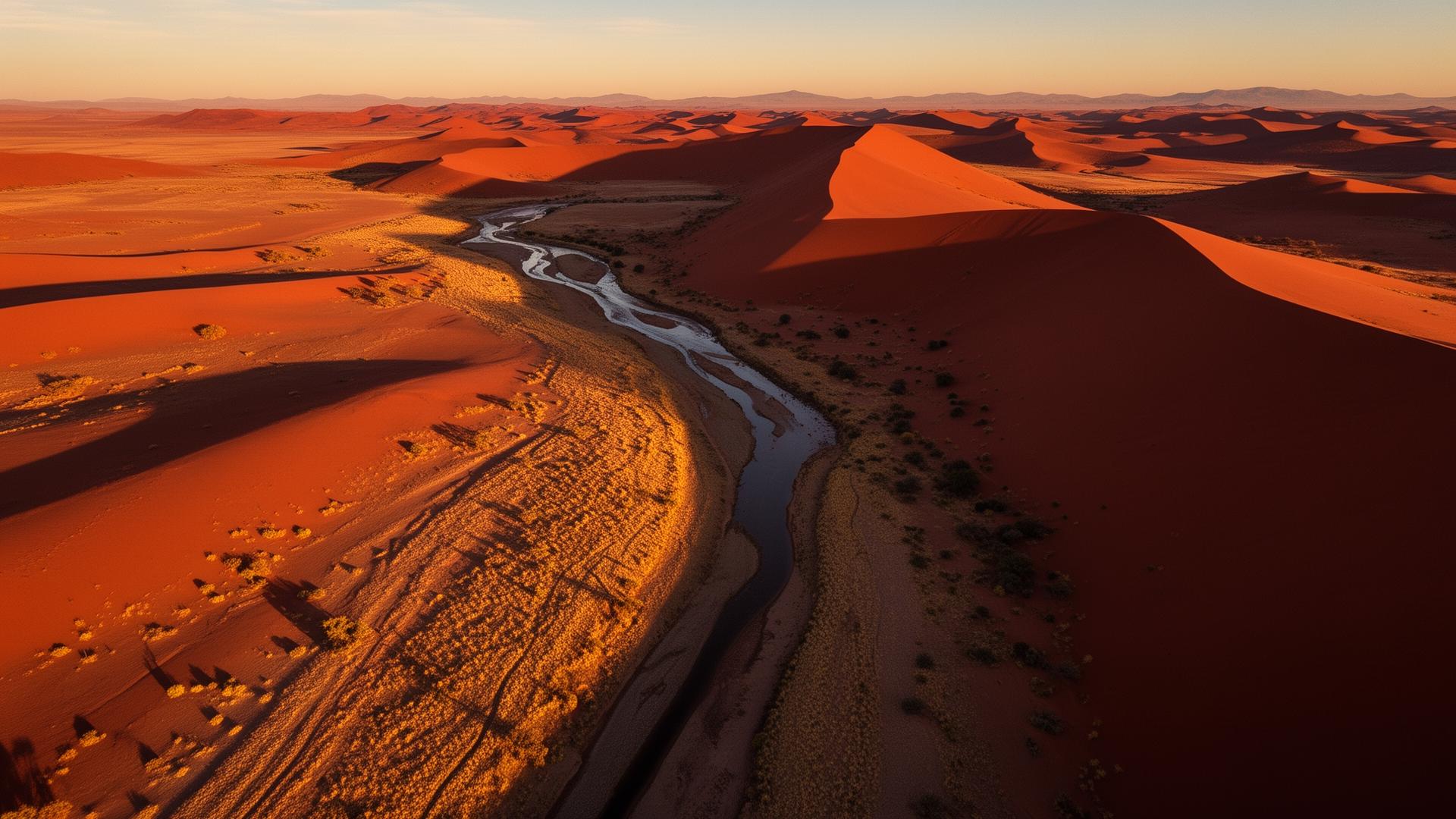

"Is Namibia safe to travel?" is the question that quietly blocks more bookings than any other. The honest answer is yes — Namibia is one of the safer countries in sub-Saharan Africa for independent travel, with stable democracy, low rates of violent crime against tourists, and a self-drive culture that actually works. But that headline answer hides what really matters: the danger that catches visitors out is almost never crime. It is the gravel road, the wildlife, the distance, and the assumption that a quiet country must also be a forgiving one. We're based in Swakopmund and we drive these roads every week. Here is the honest 2026 picture — what is genuinely safe, what to actually watch for, and the few specific local scams worth knowing about before you go.
On this page12The headline: what the major travel advisories actually say · The real danger isn't crime — it's the gravel …
- 1.The headline: what the major travel advisories actually say
- 2.The real danger isn't crime — it's the gravel
- 3.The other road risk: head-on crashes on the B2
- 4.Windhoek and Swakopmund: what to actually watch for
- 5.The Spitzkoppe scam — and other small everyday things
- 6.Wildlife: the rules that keep you safe (and the ones visitors break)
- 7.Solo travel and solo female travel — the honest specifics
- 8.Family travel safety — what changes with kids
- 9.Fuel, breakdown, signal — the practical safety net
- 10.Border areas and the regions worth a second look
- 11.Emergency numbers and what to have in the car
- 12.What we'd tell a friend booking next month
The headline: what the major travel advisories actually say
The four advisories most visitors check (US State Department, UK FCDO, Canada, Australia) are broadly aligned on Namibia. Australia rates it "Exercise normal safety precautions" — the same level as Japan or Portugal. Canada rates it "Exercise a high degree of caution." The US sits at Level 2, "Exercise increased caution," mainly because of crime in Windhoek and Walvis Bay at night, and the UK FCDO's guidance is in line with that. None of them advise against travel to any part of the country, which is unusual in southern Africa — South Africa has multiple Level 4 "do not travel" zones, Mozambique has parts under Level 4, and Zimbabwe has standing cautions Namibia simply doesn't have.
What this means in practice: Namibia is on the safe side of the African travel-safety spectrum, comparable to Botswana and Rwanda for tourist safety, and the advisories' real warnings concentrate on two things — petty/opportunistic crime in two cities, and the road. We'll cover both honestly below.
Quick check
Is this you?
The real danger isn't crime — it's the gravel
If we could change one thing about how visitors plan a Namibia trip, it would be moving the safety conversation off "is it safe?" and onto "how do I drive here?" Namibia loses around 400–450 people on its roads every year on a population of about 2.6 million — a fatality rate several times higher than Western Europe — and the data the AA Namibia and Road Safety Council publish each year is consistent: speed and loss of control on gravel, particularly single-vehicle rollovers, is the dominant cause. Tourist deaths in Namibia almost always trace back to a 4x4 going too fast on a corrugated gravel road, not to crime.
The good news is that this risk is almost entirely in your control. The 80 km/h legal limit on gravel exists for a reason; we drive most C-roads at 70–80 and rough D-roads at 50–60. Don't drive after dark — animals on the road and unlit local traffic make night driving the single most dangerous thing you can do here. Plan distances honestly (Google Maps lies about Namibia, and we have a whole article on that). And accept that a 4x4 is not a licence to go faster — most expensive rental claims start with a driver who treated the bigger car as permission to push the gravel.
If you only read one safety paragraph before your trip, make it this one. Drive 70 on gravel, never at night, and you have removed the largest single risk Namibia poses to visitors.
The other road risk: head-on crashes on the B2
Gravel rollovers are the headline risk, but on tar the dominant fatal pattern is different — it is head-on collisions caused by overtaking. The single worst stretch for this is the B2 between Windhoek, Okahandja, Karibib, Usakos, Swakopmund and Walvis Bay. It is the country's main freight corridor to and from Walvis Bay port, which means a constant stream of long-haul trucks, and the road is mostly single-lane in each direction with long blind rises. The Namibian press reports fatal head-on crashes on this corridor with grim regularity, and they almost all share the same pattern: a passenger car committing to an overtake that the geometry of the road did not actually allow.
The practical rule is simple and worth following even when it costs you ten minutes: never overtake unless you can see at least a kilometre of clear, straight road ahead. If you cannot see over the next rise, sit behind the truck — at a safe following distance, not tucked into its draft where you cannot see oncoming vehicles either. Assume that an oncoming car may itself be in the middle of overtaking and pointed straight at you, and leave yourself room to brake onto the shoulder. The B2 looks like an easy European-style A-road. It is not driven like one.
Windhoek and Swakopmund: what to actually watch for
Windhoek is a small capital — about 430,000 people — and by day it is a normal mid-sized African city. Independence Avenue, the Old Brewery, the Craft Centre, Joe's Beerhouse, the museums, and the residential suburbs around Klein Windhoek are all comfortable to walk. The honest cautions are the standard ones: don't walk the city centre alone after dark, don't leave anything visible in a parked car, use Yango, Lefa, or a hotel-arranged driver at night rather than walking, and be alert at ATMs (use ones inside shopping centres, not on the street). Bag-snatching at petrol stations and parking lots does happen — keep your phone and bag inside the cabin, not on the passenger seat.
Swakopmund — where we're based — is genuinely one of the calmest small towns you will visit anywhere. The German-colonial old centre, the beachfront, Tiger Reef and the Strand, the jetty area, and the lodges out toward Vineta are all safe to walk by day and largely fine after dark. Even so, the same parking-lot rules apply: don't leave cameras, drone bags, or laptops visible in a parked vehicle — most rental theft incidents in Swakopmund are smash-and-grab from windows, in broad daylight, in busy parking areas. Walvis Bay, half an hour south, has a slightly higher petty-theft rate around the harbour and at night; treat it as you would any small port town.
What you almost certainly won't encounter: armed robbery, mugging, kidnapping, or violent crime against tourists. The State Department's Level 2 phrasing is calibrated for global comparison, not because Windhoek is dangerous in any absolute sense — it is mainly there because of opportunistic crime that disappears when you take normal precautions.
The Spitzkoppe scam — and other small everyday things
There is one specific local scam worth knowing about because it has been running for at least two years and was officially flagged by the Allgemeine Zeitung in 2024. On the D1918 — the gravel road between Henties Bay and Spitzkoppe — an older man with a parked car (sometimes a sedan, sometimes a small bakkie) flags down tourists pretending he has run out of fuel. He tells a long, convincing story and asks for cash to buy petrol; a younger man usually stays sitting in the car. It has been reported repeatedly with the same person and the same vehicles. Henties Bay locals confirm it has been going on for years.
It isn't dangerous. He doesn't threaten anyone, he doesn't rob anyone — it's a cash scam aimed at the goodwill of self-drivers who'd naturally stop to help a stranger in the desert. The right response: don't hand over money, drive on, and report it at the next rest camp or police station (Henties Bay has both). If someone genuinely needs help in Namibia, calling for assistance via their own phone or flagging a passing local works just as well — locals here help each other constantly, and you won't be the difference between a working car and a stranded one.
Beyond that, the everyday things to be aware of are mundane: "helpers" at supermarket parking lots in Windhoek and Swakopmund expecting a small tip (N$5–10 is normal); informal car-guards at restaurants doing the same; occasional unofficial "guides" at fuel stops or border posts. None of this is threatening — it's simply how the informal economy works, and a small note handed over with a smile resolves it instantly.
Wildlife: the rules that keep you safe (and the ones visitors break)
Namibia's wildlife is, statistically, less dangerous to tourists than its roads. The serious incidents that do happen — and there are a handful every year — almost always come from visitors breaking simple rules. Stay in your vehicle in Etosha, full stop. Don't get out for photos, don't approach a waterhole on foot, don't open a door for a better angle. Elephants, especially in Damaraland and the Kunene, deserve serious distance — 100 metres minimum if a bull is alone, more if there are calves. Lions and hyenas around Etosha camps are real and pass through fence-lines at night; food belongs in vehicles and rubbish belongs in proper bins, not next to your tent.
Snake bites are rare but real on hiking routes — the Spitzkoppe rocks, the Naukluft trails, parts of Damaraland. Wear closed shoes, watch where you put your hands climbing, and don't reach into rock crevices. Scorpions live in shoes left outside tents — shake them out in the morning. Ticks happen in the Caprivi and Kunene. None of this requires gear you wouldn't take to a US national park, but it does require attention. We have a separate article on wildlife distance and vehicle behaviour rules — link in your route review if Etosha or Damaraland is on your itinerary.
Solo travel and solo female travel — the honest specifics
Namibia is one of the most solo-friendly countries in Africa. The self-drive culture means you're never reliant on guides, the lodge network is well-spaced and welcoming to single travellers, and the country's low population density means you can go for hours without seeing anyone — a feeling that's freeing for some travellers and unnerving for others. The standard safety practices are the standard ones anywhere: share your daily route with someone, don't drive after dark, fuel up earlier than you think you need to, and keep your accommodation aware of your arrival window.
For solo female travellers specifically, Namibia is widely rated as comfortable — easier than South Africa, comparable to Botswana. Lodge staff are accustomed to female solo guests; restaurants in Swakopmund, Windhoek, and Lüderitz are perfectly normal places to dine alone. Catcalling and street harassment are far less common than in many Western European cities. The realistic cautions: avoid walking alone at night in Windhoek and Walvis Bay, be deliberate about which campsites you choose if camping (community-run sites with a permanent host beat unsupervised wilderness camps), and trust your instincts — if a place feels off, leave. We have dedicated solo and solo-female guides linked in your route review.
Family travel safety — what changes with kids
Namibia is excellent for family self-drive — better than most parents expect. The genuine safety considerations are different from the adult ones: heat (carry far more water than feels necessary, and don't leave children unattended in vehicles even briefly), sun (the UV index in the dunes regularly hits extreme levels), and fatigue (long gravel days exhaust kids in ways adults underestimate). Wildlife rules apply tenfold to kids — they cannot be allowed to wander at lodges with open boundaries (Etosha private reserves, Damaraland, parts of the Kalahari), even in daylight.
The medical realities: Namibia's main hospitals (Windhoek, Swakopmund) are competent and reachable in roughly half a day from most of the country. Rabies exists — don't let kids approach unknown dogs, monkeys, or bats. Malaria is a real consideration in the Caprivi and northern Kavango, but the classic loop (Sossusvlei, Swakopmund, Etosha) is malaria-free or very low risk. We have a dedicated family route guide that builds the schedule around these realities.
Fuel, breakdown, signal — the practical safety net
The thing that makes Namibia feel intimidating to first-timers is distance. The thing that makes it manageable is preparation. Fuel up at every town — never assume the next station is open. Carry at least 5 litres of drinking water per person per day in the car, regardless of how short the leg looks. Have a way to call for help that doesn't depend on cell signal, because most of the country doesn't have it (a satellite messenger like a Garmin inReach is what we recommend for any leg longer than a day off the main routes). MTC and TN Mobile SIM cards work well on tar and main C-roads; signal disappears in the deep desert, the Kunene, and most of Damaraland.
If you break down: stay with the vehicle. Don't walk for help unless you can see the destination clearly and it's within an hour. Vehicles pass eventually on every road we send clients down; we have an article on the specific Sesriem-Solitaire breakdown protocol that applies to most other remote stretches too. The lodge that booked your room will help; the rental company has a 24-hour line; AA Namibia's roadside assistance number is +264 81 555 9432, and it works for visitors with rental cars too.
Border areas and the regions worth a second look
Three regions get more nuanced advisory language: the Angolan border in the far north, the Caprivi/Zambezi strip, and the Kavango. None of them are unsafe for travellers on standard tourist routes — Caprivi self-drive itineraries are common and we plan them regularly — but they require slightly more attention. Don't cross the Angolan border informally. Don't drive at night in Caprivi (elephants on the B8 are a genuine risk). Don't free-camp in the Bwabwata area; use the established camps.
Kaokoland and the deep Kunene are remote rather than dangerous. The risks are mechanical and logistical (broken vehicle, no fuel, no signal), not criminal. These trips need a second vehicle, a satellite messenger, and someone in your party who has driven the route before — not because of any threat, but because Namibia simply doesn't intervene to rescue you quickly when you are 200 km from a graded road.
Emergency numbers and what to have in the car
Save these before you fly: Police 10111, Ambulance 211 111 (Windhoek) / 112 from a mobile, AA Namibia roadside assistance +264 81 555 9432, your lodge's direct number for each night of the trip, your rental company's 24-hour line, and your travel insurer's emergency assistance number. Take a screenshot — these need to work without signal long enough to dial.
In the car, beyond what the rental gives you: 5 litres of water per person per day, a printed copy of your itinerary with lodge names and phone numbers, a basic first-aid kit, sunscreen, a hat, a torch, and a spare phone charger with a 12V adapter. If you're going off main roads, add a satellite messenger, a tow strap, and a tyre repair plug kit — flat tyres on gravel are routine, and the spare doesn't always come with another spare.
What we'd tell a friend booking next month
If a friend asked us tomorrow whether Namibia was safe enough for their first African self-drive, the answer would be yes — comfortably yes — with three pieces of honest advice: drive 70 on gravel and never at night, treat Windhoek with the same caution you'd give any unfamiliar city, and assume the country won't reach out to help you the way a European country would, so prepare your own safety net (water, fuel, satellite messenger if you go remote, lodge phone numbers in writing).
Do those three things and Namibia is, genuinely, one of the more relaxing major trips you can take. The fear that lives in the headline question — "is it safe?" — almost never matches the reality on the ground. The real risk is on the road, it is in your hands, and it is removable.
Frequently asked questions
Is Namibia safe for tourists in 2026?
Yes. Namibia is rated "exercise normal safety precautions" by Australia and Level 2 ("exercise increased caution") by the US — among the safer ratings in sub-Saharan Africa. Violent crime against tourists is rare. The biggest real risk is road accidents on gravel, not crime.
Is Windhoek safe at night?
Walking the city centre alone at night isn't recommended. Use Yango, Lefa, or a hotel-arranged driver after dark, eat at restaurants in Klein Windhoek or your hotel, and don't carry visible valuables. Daytime Windhoek is a normal small capital and comfortable to explore on foot.
Is it safe to self-drive in Namibia?
Yes, with discipline. Stay under 80 km/h on gravel (we drive most gravel at 70), never drive after sunset, fuel up at every town, carry 5 litres of water per person per day, and don't treat a 4x4 as permission to drive faster. Single-vehicle rollovers from speeding on gravel cause most tourist road incidents.
Is Namibia safe for solo female travellers?
Widely rated yes — easier than South Africa, comparable to Botswana. Lodges are welcoming to solo female guests, street harassment is uncommon, and the self-drive culture means you're never reliant on guides. Avoid walking alone at night in Windhoek and Walvis Bay, and choose campsites with a permanent host if camping. We have a dedicated solo-female guide.
Is the water safe to drink in Namibia?
Tap water in Windhoek, Swakopmund, and most towns is safe and treated. At remote lodges and campsites, ask — most use borehole water that is fine, but bottled is widely available and cheap. Always carry plenty in the car regardless.
Is there a scam to know about between Henties Bay and Spitzkoppe?
Yes. On the D1918 gravel road, an older man with a parked car asks tourists for cash claiming he has run out of fuel — a fabricated breakdown story. It has been running for years and was officially flagged by Namibian press in 2024. Not dangerous; just don't hand over money, drive on, and notify the next rest camp or police station.
Do I need vaccinations or anti-malarials for Namibia?
Standard travel vaccines (hepatitis A, typhoid, tetanus up to date). Yellow fever certificate required only if arriving from a yellow fever country. Anti-malarials are recommended for the Caprivi/Zambezi and northern Kavango; the classic loop (Sossusvlei, Swakopmund, Etosha) is low-risk to malaria-free. Consult a travel doctor with your specific route.
Final verdict
Namibia is genuinely one of the safer self-drive destinations in Africa — but "safe" here means something specific: low crime, stable politics, welcoming people, and a road network that punishes overconfidence. Get the driving right and the rest takes care of itself. If you want a second pair of eyes on a route before you book, we read every itinerary against exactly the safety realities above.
Kian, Inside Namibia· Based in Swakopmund · desert specialist
I live in Swakopmund and spend most of my time in the desert — I know its dunes, its silences, and most of the snakes you'd rather not meet. My favourite stretches are the loneliness of Damaraland and the birding in Caprivi, and that's the lens I bring to every route I review.
Want a second pair of eyes on the safety side of your route?
Send us your draft itinerary and we will flag the legs where the gravel, the distance, or the timing add real risk — and exactly what to change. Most reviews come back the same week.