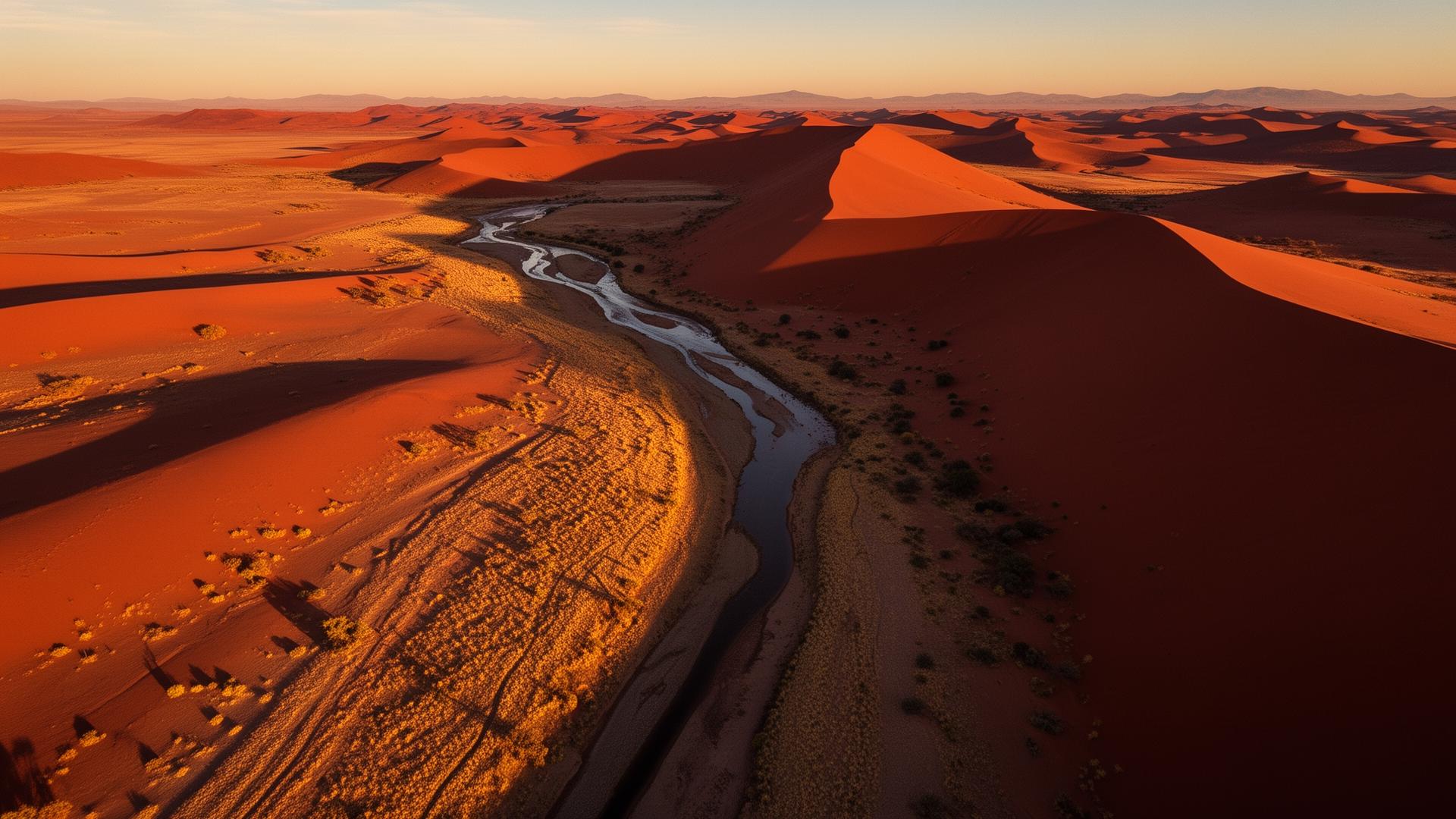

On 14 days the Caprivi is a luxury that costs you Damaraland or two of three Etosha nights. On 16, it stops costing anything — provided the route is built around the strip from day one instead of tacked onto the end of a classic loop. The version below is the one we plan when a couple says 'we want Namibia plus the green wet bit, and we don't want to feel rushed at either end'.
On this page7Who 16 days in Namibia + Caprivi suits · The 16-night shape, night by night …
- 1.Who 16 days in Namibia + Caprivi suits
- 2.The 16-night shape, night by night
- 3.The two transfer days nobody warns you about
- 4.What the Caprivi gives you that nowhere else in Namibia does
- 5.Lodges we put on this route
- 6.Vehicle, season, and the few things that actually matter
- 7.Where this route quietly breaks if you change a piece
Who 16 days in Namibia + Caprivi suits
The traveller this route fits cleanly is a returning visitor, or a first-timer with three weeks of holiday and a clear preference for green-water wildlife on top of the dunes. Couples and small groups; not families with under-tens, where the long Caprivi transfer days punish everyone in the car.
It does not suit travellers who want the southern loop (Fish River, Lüderitz, NamibRand) on the same trip. Sixteen days is enough for north or south, not both. If the south is also non-negotiable, you're in 21-day territory, and we plan that as a different shape.
Quick check
Is this you?
The 16-night shape, night by night
Arrival night near Hosea Kutako or Windhoek. Two nights Sossusvlei. Two nights Swakopmund (the coast reset before the long northern push). Two nights Damaraland. Three nights Etosha (south camp + east camp split — Okaukuejo and Namutoni, or Onguma). Then the long transfer day east on the B1 / B8, with one night at Roy's or Hakusembe to break the drive. Three nights inside the strip — Kwando, Mudumu/Nkasa Rupara, Chobe-front. Last night near Kasane or Victoria Falls, fly out from there.
The single most common mistake we see on owner-built versions of this trip is trying to do it as a loop back to Windhoek. That adds two full driving days through ground you've just covered. End at Kasane or Vic Falls. The one-way drop-off fee is real — usually N$8,000–14,000 — but it buys back the two days that would otherwise vanish on the return.
- Nights 1: Windhoek arrival
- Nights 2–3: Sossusvlei
- Nights 4–5: Swakopmund
- Nights 6–7: Damaraland (Twyfelfontein / Palmwag)
- Nights 8–10: Etosha (south + east)
- Night 11: Roy's Rest Camp or Hakusembe (B8 transit)
- Nights 12–14: Caprivi (Kwando · Mudumu · Chobe-front)
- Night 15: Kasane / Vic Falls
- Night 16: optional Vic Falls extension or fly-out
The two transfer days nobody warns you about
Etosha east gate (Von Lindequist) to Rundu is around 480 km — a long but doable day on tar. Rundu to your first Caprivi lodge is another 250–400 km depending on whether you're aiming for Kwando (further) or Hakusembe (closer). Either way, the Etosha → Caprivi push needs a buffer night, not a single 12-hour drive. We use Roy's Rest Camp, Hakusembe River Lodge or Mahangu Safari Lodge as the buffer. Cheap, clean, exists for exactly this purpose.
Then on the eastern end, the Kasane border crossing at Ngoma is straightforward but adds 60–90 minutes; allow it. Don't book a Vic Falls helicopter flight for the same afternoon you cross.
What the Caprivi gives you that nowhere else in Namibia does
Water. Namibia outside the strip is a country built around the absence of water — the wildlife concentrates at engineered waterholes, the photography is about light on dryness, the lodges turn their architecture toward sunset. The Caprivi reverses every part of that. Boat trips at sunset on the Kwando, hippos in the channel below your room, elephants crossing the river at first light, fish eagles loud enough to wake you. The wildlife densities on the Chobe river front are among the highest in Africa.
It also gives you the easiest crossing into Botswana you'll find on a self-drive. From the eastern strip you can cross to Kasane and add a Chobe day-cruise, or push 90 minutes further to Victoria Falls. The Caprivi is the natural bridge into a wider southern Africa trip — that's why it's there as a shape, not as a side-trip.
Lodges we put on this route
Western Caprivi: Nambwa Tented Lodge (mid-premium, on the Kwando inside Bwabwata) or Camp Kwando (mid-range, river-front). Both put you in the right ecology on day one inside the strip.
Central Caprivi: Nkasa Lupala Tented Lodge — the wettest, most Okavango-like part of Namibia, seasonally flooded, best from late dry into early wet (Sep–Dec). For a quieter night with the same access, Livingstone's Camp on Mudumu's edge.
Eastern Caprivi: Chobe River Camp or Ichingo Chobe River Lodge — both put you on the river front for the morning boat cruise. From here it's a 30–45 minute hop to the Kazungula border for Vic Falls.
Vehicle, season, and the few things that actually matter
The B8 is fast paved tar; the lodge access tracks range from easy gravel to deep sand and seasonal mud. A 4x4 (Hilux double-cab or Fortuner) is the right tool here, not a luxury. AWD soft-roaders (RAV4, Duster) will struggle on the wet-season access roads.
Best months are May–October — dry, animals concentrate on the rivers, lodge access easy. November–March is the wet season — fewer guests, lower rates, dramatic skies, but mud closures on the Mudumu/Nkasa side are real and can rearrange your plan in 24 hours. We don't recommend the wet-season version of this route to first-time visitors.
Where this route quietly breaks if you change a piece
Cutting the Damaraland nights to free up time for a third Caprivi night: don't. The two regions are doing different work in the trip — Damaraland is the dry, slow, cinematic counterweight to the wet eastern half. Without it, the Caprivi feels untethered.
Replacing the Roy's buffer night with a longer driving day from Etosha: also don't. We see this attempted once a quarter and it ends with someone arriving at Hakusembe after dark on a road they don't know. The buffer is N$1,200 per couple. The risk it removes is not worth saving.
Looping back to Windhoek to save the one-way drop-off fee: this is the single largest unforced error on this route. Two days of your trip costs more than the drop-off fee. Always.
Final verdict
Sixteen days through Namibia and out via the Caprivi is one of the strongest routes we plan. It rewards a returning visitor with a different country in the second half of the trip, and it gives a first-timer with three weeks the only reasonable shape for doing both halves of Namibia properly. We plan and pressure-test these routes for the lodge bookings, the buffer nights, the one-way drop-off, and the Botswana paperwork — the things that decide whether the trip you imagined is the trip you actually take.
Kian, Inside Namibia· Based in Swakopmund · desert specialist
I live in Swakopmund and spend most of my time in the desert — I know its dunes, its silences, and most of the snakes you'd rather not meet. My favourite stretches are the loneliness of Damaraland and the birding in Caprivi, and that's the lens I bring to every route I review.