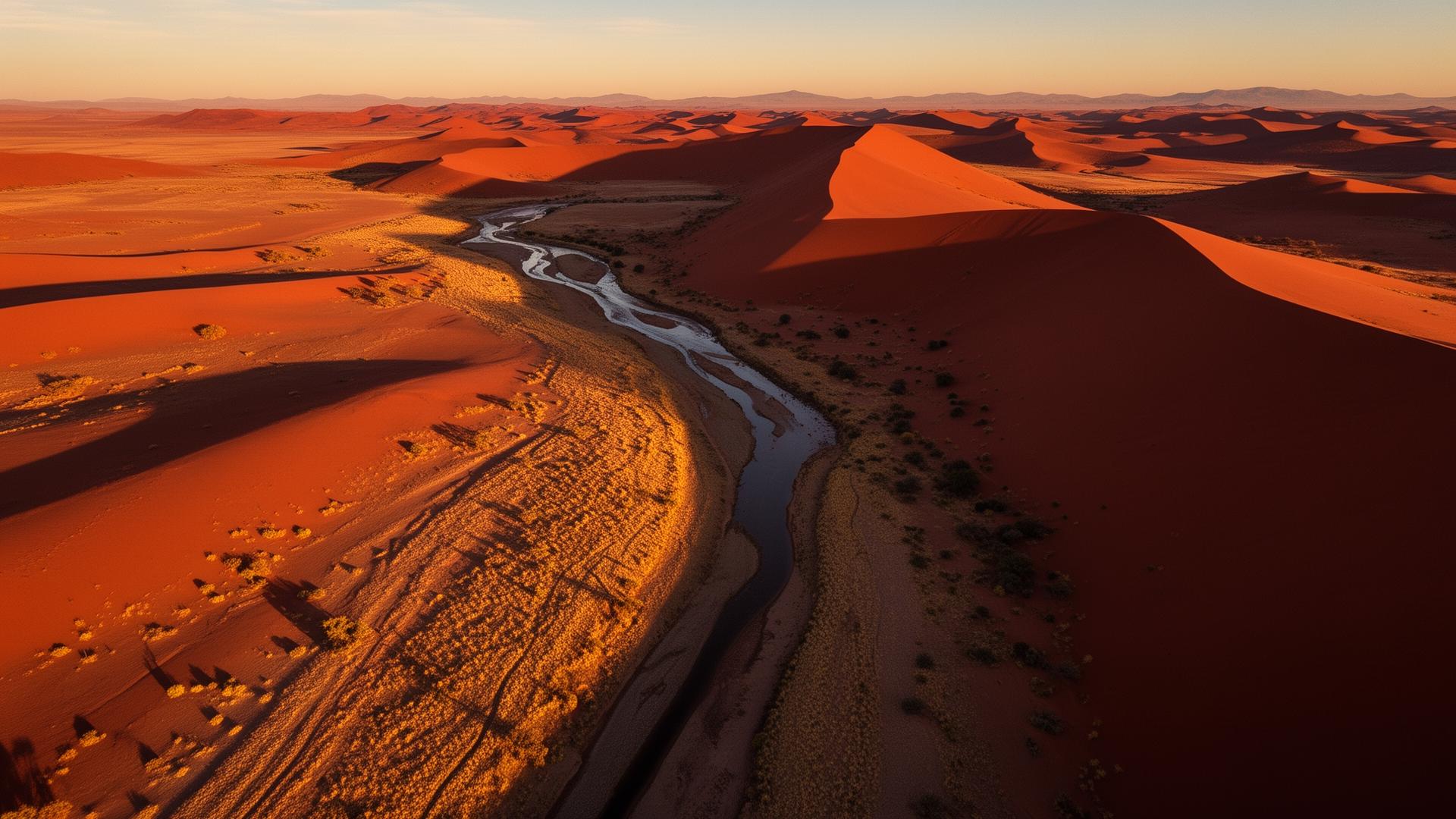

Namibia is the African country we recommend most often to first-time solo self-drivers. The road network is good, traffic is light, the people are unusually calm, and the lodges along the standard routes are well-used to solo travellers. None of that means it is risk-free. Solo travel here lives in a different risk profile than solo travel in, say, Cape Town — petty crime is rare, but breakdown-with-no-cell-signal is a real failure mode, and a sprained ankle on a Damaraland trail is a different problem when there is nobody else to drive you to a clinic. The notes below are the version we give to solo travellers calling us, including the specifics that the more cheerful guides leave out.
On this page6What 'safe' actually means in Namibia · The cell coverage map (the contrarian piece) …
What 'safe' actually means in Namibia
Most generic 'is country X safe?' articles are useless because they pool all risk types together. For solo travel in Namibia, three risk categories matter and they are uneven. Personal-safety risk along the standard self-drive routes (Sossusvlei, Swakopmund, Damaraland, Etosha, Windhoek) is genuinely low — Namibia does not have the petty-crime baseline of Cape Town or Johannesburg, and the lodge-to-lodge route puts you in a chain of well-staffed properties. We do not pretend Windhoek city centre is risk-free at night (it is not), but the day-to-day routine of pick up car, drive to lodge, settle in, do a guided activity, sleep is one of the lowest-risk Africa trips on offer.
Mechanical and medical risk is where solo travel diverges from couples travel. A flat tyre on the C39 with no other car for 90 minutes is a 20-minute fix as a couple and a 60-minute fix alone. A twisted ankle on the Sossusvlei dunes is a problem you can shrug off in a group and a day-changer alone. The mitigations below are about the second category, not the first.
Female-solo-specific risk in Namibia is something we have asked solo female travellers about repeatedly over years of advisory calls. The honest aggregate answer is that they report fewer issues than they expected — less catcalling than in Cape Town, no menacing approaches at fuel stops, lodge staff that treat solo women with genuine respect. The two situations to be alert to are Windhoek nightlife (treat like any African capital — taxis after dark, not walking) and overland buses or hitchhiking (we do not recommend these for solo female travellers; the road network is built around private vehicles).
Quick check
Is this you?
The cell coverage map (the contrarian piece)
Most articles say 'cell coverage in Namibia is patchy' and stop. That is not useful. The real picture: MTC's network covers the tarred B-road network and most major C-road towns reliably. Lodges along the standard route almost all have either tower-fed signal or onsite Wi-Fi. The gaps are specific and predictable: long stretches of the C14 (Sesriem to Solitaire), most of the C39 between Khorixas and Palmwag, the C40 west of Kamanjab, the entire D2620 to Purros, and the gravel approach to Sossusvlei from Sesriem.
For solo travellers, the practical implication is to plan one cell-signal check-in per day from a known point — most lodges have signal. Tell someone (a partner, a parent, a friend) the next day's route before you leave the lodge and the expected arrival time at the next lodge. If you do not arrive within 90 minutes of the expected time, the lodges in Namibia have an informal but real network — your destination lodge will call your origin lodge to start a check.
Buy a Namibian SIM at the airport (MTC has a kiosk at WDH and Walvis Bay), top it up with a 5GB tourist data bundle (~N$200), and you are sorted for the trip. UK and EU roaming on Namibian networks is technically possible but 5–10x the cost. The local SIM is a one-time hassle that pays back inside a day.
- Reliable: All B-roads, C24/C26 (Windhoek-Sesriem corridor), C38 (Etosha approach), B1 entire length, all towns >2000 people
- Lodge-only signal: Most lodges along the C14 (Sesriem-Walvis Bay), C39 (Khorixas-Palmwag), Damaraland in general
- Effectively dark: C40 west of Kamanjab, D2620 to Purros, anything north of Sesfontein, Skeleton Coast north of Möwe Bay
- Buy local: MTC SIM at the airport, ~N$50 for SIM + N$200 for 5GB tourist bundle, lasts the trip
SATIB Rescue: the single most important paragraph
SATIB is a Namibian insurance broker that sells a specific, cheap product called SATIB Rescue. For around N$200 per person per trip, it covers helicopter evacuation from anywhere in Namibia to a hospital — the exact scenario that a sprained ankle on the Sossusvlei dunes, a tyre-change injury on a remote C-road, or a serious illness at a lodge can become. Standard international travel insurance does not cover air evacuation in most policies, or covers it at limits below what a Namibian helicopter rescue actually costs.
For couples and families, this is a useful add-on. For solo travellers, it is the difference between a manageable problem and a crisis. There is no second driver to take you to a clinic; there is no second person to call your insurer while you wait. SATIB Rescue can be bought online at satib.com.na before the trip; the lodge reception in Sesriem and Etosha can also help register you on arrival. We do not have a financial relationship with SATIB — we just send every solo traveller their way.
Solo dining at lodges: how it actually works
The thing solo travellers worry about that almost never turns out to be a problem is dinner. The lodge dining cultures along the standard Namibia route are unusually solo-friendly. Many Gondwana lodges (Canyon Lodge, Damara Mopane, Etosha Safari Lodge) and Wilderness camps run a single long communal table at dinner where solo travellers, couples and families eat together. You opt in on arrival — the lodge reception will ask whether you want a private table or to join the communal table. We recommend the communal table for at least the first night; you meet other travellers, swap road notes, and the trip feels less isolating from night one.
Premium safari camps (Wolwedans, Little Kulala, Onguma The Fort) typically use private tables but the staff are well-trained on solo guests — the room rate often includes a guide-led pre-dinner drinks gathering where solo travellers meet other guests, then dine private. Mid-range lodges (Le Mirage, Mokuti, Strand Hotel Swakopmund) run conventional restaurants where eating solo is normal and unremarkable.
The single supplement is the financial side of this. Most lodges charge 50–80% of the per-person rate as a single supplement, which means a solo traveller pays roughly 1.5–1.8x what one of two people would pay. A few solo-friendly properties (Klein-Aus Vista, Onguma's smaller camps, some NWR rest camps) charge a lower supplement or none at all. If single supplement matters to your budget, ask before you book — the operator can usually steer you to the cheaper-supplement properties without changing the route shape.
Fuel stops: the social piece
Namibian fuel stations are full-service — you stay in the car, the attendant fuels and (if you ask) cleans the windscreen. Tipping is N$5–10 in coins; nobody minds if you forget but everyone notices if you remember. Card payment works at most stations on the main routes; smaller stations sometimes need cash. Carry N$500 in small notes and coins for the trip — it covers fuel-tip-and-coffee for two weeks.
Solo female travellers we have advised report no issues at fuel stops along the standard routes. Attendants are professional, the wait is short (1–3 minutes typically), and the stations are visible from the road. Windhoek city stations after dark are the one we recommend avoiding — fuel up before the city in late afternoon if your route ends there.
The rural fuel-stop social norm is that you greet the attendant ('hi, how are you' is enough), let them fuel, pay, and go. In a cafe attached to a fuel station (Solitaire is the famous one), single solo travellers are common and unremarkable — order, eat, leave a tip, no story to tell.
What we recommend solo travellers cut
Two things we routinely advise solo travellers to skip on a first Namibia trip. First, the deep Damaraland tracks beyond Palmwag — they are wonderful but they are also the country's worst combination of remote, rough, and cell-signal-free. If you are an experienced 4x4 driver and plan a multi-day desert track, find a second driver to convoy. Solo on the Hoanib or the Marienfluss is the kind of risk we discourage even from experienced clients.
Second, the Spitzkoppe summit hike. The base of Spitzkoppe is fine for a solo morning. The summit is a properly technical climb that has had fatal accidents and should not be attempted solo. The Bushman's Paradise rock art and the granite arches at the base are the version that delivers without the risk.
Both of these reflect our general line: Namibia along the standard self-drive routes is one of the easiest solo trips in Africa. Off-route remote Namibia is one of the harder ones, and not the trip we recommend for a first solo visit.
Frequently asked questions
Is Namibia safe for solo female travellers?
Yes, along the standard self-drive routes. Solo female travellers we have advised report less harassment than in Cape Town, no problems at fuel stops, and lodge staff that treat solo women professionally. The exceptions are Windhoek nightlife (treat like any African capital — taxis after dark) and overland buses or hitchhiking (not recommended for solo female travellers). The country's main risk profile is mechanical and medical, not personal-safety.
What insurance do solo travellers in Namibia need?
Standard international travel insurance plus SATIB Rescue (~N$200 per person per trip), which covers helicopter evacuation from anywhere in Namibia. Standard insurance rarely covers air evacuation at the limits Namibian rescue actually costs. For solo travellers, SATIB is non-optional — there is no second person to take you to a clinic if something goes wrong on a remote road or trail.
Will I have cell signal on Namibia gravel roads?
Mostly no. Tarred B-roads have signal almost everywhere; major C-roads have signal in towns and at lodges; D-roads and remote C-roads (C40 west of Kamanjab, D2620 to Purros) are dark. Buy a local MTC SIM at the airport (~N$200 for a 5GB tourist bundle) and plan one signal check-in per day from a known point. Tell someone your daily route and ETA at the next lodge before you leave.
How much extra does solo Namibia travel cost (single supplement)?
Most lodges charge a 50–80% single supplement, meaning a solo traveller pays roughly 1.5–1.8x what one of two sharing pays. A few properties (Klein-Aus Vista, Onguma's smaller camps, NWR rest camps) charge less or no supplement. If budget matters, ask the operator to steer the route through lower-supplement lodges without changing the trip shape.
What should I avoid as a solo traveller in Namibia?
The deep Damaraland tracks beyond Palmwag and any solo 4x4 expedition into Kaokoland — find a convoy partner if you want this trip. The Spitzkoppe summit climb (technical, fatal accidents have happened, do the base instead). Windhoek city centre on foot after dark. Hitchhiking and overland buses. Otherwise the standard self-drive route is one of the easiest solo Africa trips on offer.
Final verdict
Most of the solo Namibia advice online is either too cautious (treating it like a Karachi-level risk profile) or too breezy (treating it like driving in Tuscany). Neither is right. The honest version is that the standard self-drive route is one of the easiest solo Africa trips on offer, with one set of mechanical-and-medical mitigations to put in place. If you want a route built around a solo profile — including the lodges that handle solo dining well — we can shape one with you on a call.
Want a solo trip shaped around real lodge and route specifics?
We plan solo Namibia trips with the lodge-by-lodge solo-dining reality, single-supplement budget targets, SATIB enrollment, and the cell-coverage check-in plan built in. Especially helpful for first solo Africa trips.