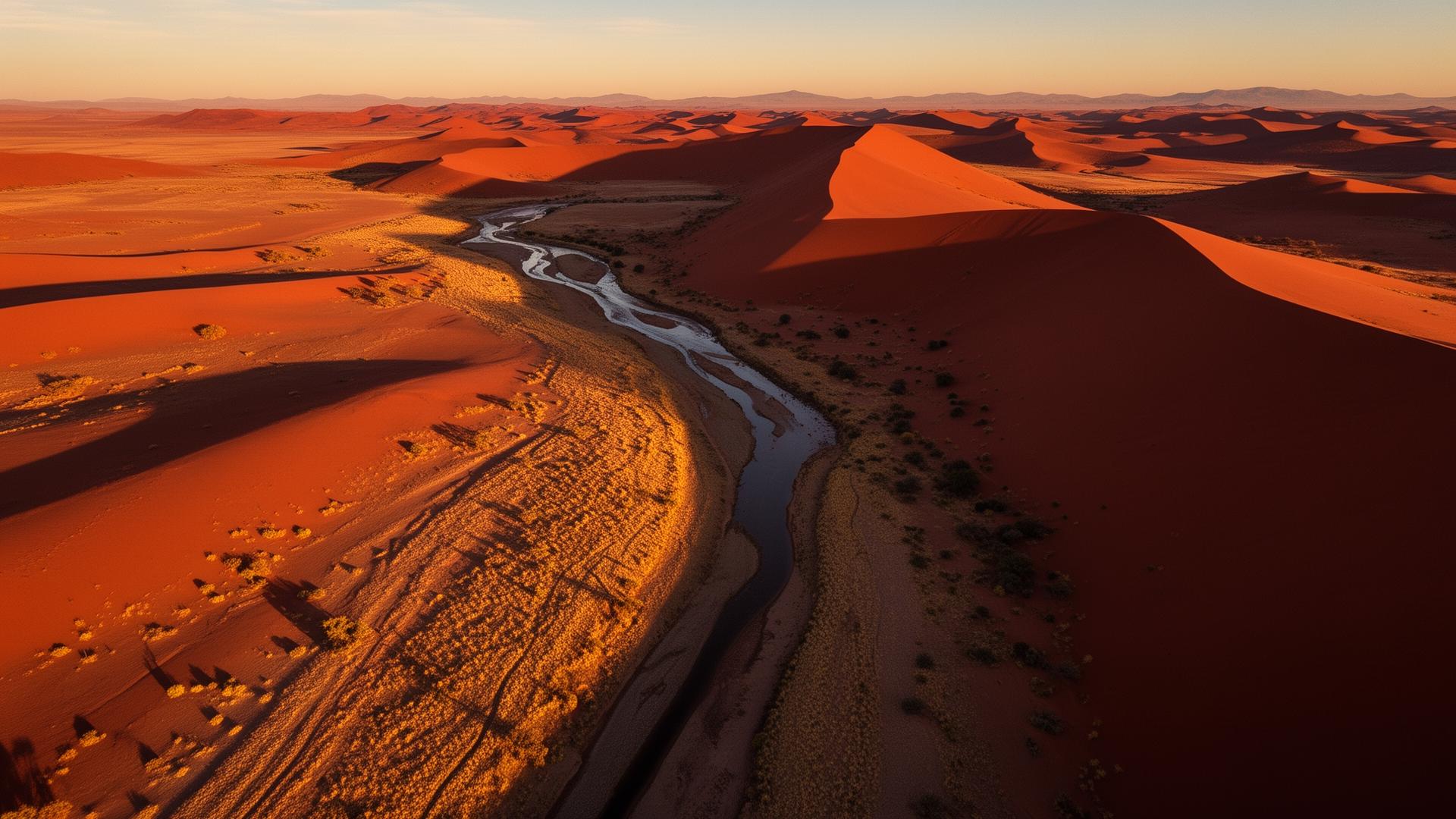

The single largest cause of self-drive crashes in Namibia is gravel-road speed. Not corrugations, not wildlife, not driver fatigue — speed on a surface that does not behave the way the driver thinks it does. The numbers below are the speeds we actually drive on the named roads, the ones we tell every client to drive, and the ones the rental insurance excess assumes you understood before you signed the contract.
On this page6Why gravel doesn't behave like tar · The honest speeds, by surface …
Why gravel doesn't behave like tar
On a tarred road, the contact patch of the tyre is in continuous mechanical grip with the road surface. On gravel, the contact patch is sliding across loose stones that are themselves sliding across the underlying compacted base. The system has roughly half the friction coefficient of tar — and the friction is non-uniform, so a stone-sized variation under one wheel can flip the grip balance instantly. The vehicle responds by oversteering. The driver corrects by countersteering. At 100 km/h, the second correction overshoots, the back end snaps, and the rollover sequence begins.
This is not a theoretical concern. It is the modal Namibia rental crash, and the reason the insurance excess on a 4x4 here runs to N$50,000–80,000 even with full waiver. The insurer has done the maths.
Quick check
Is this you?
The honest speeds, by surface
Good Namibian gravel — graded recently, no corrugations, no loose top layer — sits between the C14 (Solitaire to Walvis Bay), much of the C19, and parts of the C39. On these roads we drive at 80 km/h with good tyres, dropping to 70 in any settlement transition or when an oncoming vehicle is approaching.
Average Namibian gravel — typical of the C28, parts of the D707, the D2620 — has a more loose surface, occasional corrugations, and is the working baseline for most travel days. We drive at 60 km/h here, and slower through bends.
Corrugated gravel — the kind of washboard surface that vibrates the entire vehicle — sits on certain D-roads (the D3710, parts of the D2612, the access into Sossusvlei after a busy week). Here, 40 km/h is the speed at which the vehicle stays on the road and the suspension survives. There is a counterintuitive theory that 80 km/h 'floats' over corrugations; it does not, and the practical result is broken shock absorbers and a write-off claim.
Sand and rock — the access tracks into Damaraland's deeper valleys, the approach to Spitzkoppe, anything labelled '4x4 only' on the lodge confirmation — runs at 20–30 km/h with deflated tyres. This is not 'slow' — this is correct.
Stopping distance: the number that decides everything
From 80 km/h on tar, a hire car stops in roughly 35 metres on dry road. From 80 km/h on gravel, the same vehicle needs roughly 55–65 metres. From 100 km/h on gravel, you are looking at 90+ metres of stopping distance — longer than most of us can hold concentration on the road ahead.
An oryx in the road at 80 km/h gives you about 2.5 seconds of reaction time at typical visibility. At 100 km/h on gravel, the maths stops working: you cannot stop, you cannot reliably swerve without losing the back end, and the only outcome that doesn't end in a crash is luck.
The corrugation paradox and why it kills suspensions
Corrugations form on gravel roads where vehicles brake and accelerate repeatedly — typically at intersections, before bridges, and on the approach to lodges. The wave pattern is regular, a few centimetres deep, and at 60–80 km/h it transmits straight into the vehicle's suspension as a high-frequency vibration.
The popular folk wisdom is that you can 'find the speed where it floats' — usually quoted as 80 or 100 km/h. The physics doesn't agree. At those speeds, the vehicle's wheels are partially airborne between corrugations, the tyre is in partial contact with the road, and steering response collapses. We see the consequence weekly: vehicles arriving at lodges with broken shocks, snapped CV joints, and exhaust mounts dangling. The repair bill is the renter's, not the rental company's. Drive at 40 km/h. Accept the noise.
When to drop another notch
Wet gravel after rain — the top layer becomes silt and the grip drops to roughly tar-in-rain. Drop 20 km/h from your normal gravel speed.
Approaching a blind crest — Namibian gravel roads have hidden dips where the next rise might conceal a stationary vehicle, a herd of cattle, or an oncoming truck spread across the centre line. Slow to 60 km/h before any blind crest, especially on the C-roads.
Tyre warning light — a slow puncture on a gravel road gives you 15 minutes of driving before the sidewall delaminates. Stop within 2 km. Do not 'try to make the lodge'.
First 30 minutes after sunrise or before sunset — the low-angle light hides corrugations and surface variation. Drop 10–15 km/h.
Dust cloud from oncoming vehicle — visibility drops to under 10 metres for a few seconds. Slow to 30 km/h, hold the steering steady, do not brake hard.
What we tell every client at the start of a trip
The single most useful sentence we give clients before they pick up the vehicle is this: the gravel will feel fine at 100 km/h, and that feeling is the trap. The vehicle will be working at the edge of its grip envelope and you will not know it until something — an oryx, a corrugation patch, an oncoming truck's dust cloud — pushes it over. Drive at 80 because 80 is what the vehicle can actually do on this surface, not because we are being cautious.
And: there is no Namibia trip that needs you to drive faster. The day's stop is at the lodge, the lodge knows you are coming, the bookings are confirmed. Slow down by 10 km/h and arrive 15 minutes later. That trade is always on offer and always worth taking.
Final verdict
Speed on Namibian gravel is the one variable on this trip you control entirely, and the one that decides whether the worst-case becomes a story or a phone call to the insurer. We brief every client on this before they leave Windhoek. If you're planning a trip with us, this is the conversation; if you're planning it yourself, treat the numbers above as the actual speeds rather than a cautious recommendation.

Kian, Inside Namibia· Based in Swakopmund · desert specialist
I live in Swakopmund and spend most of my time in the desert — I know its dunes, its silences, and most of the snakes you'd rather not meet. My favourite stretches are the loneliness of Damaraland and the birding in Caprivi, and that's the lens I bring to every route I review.