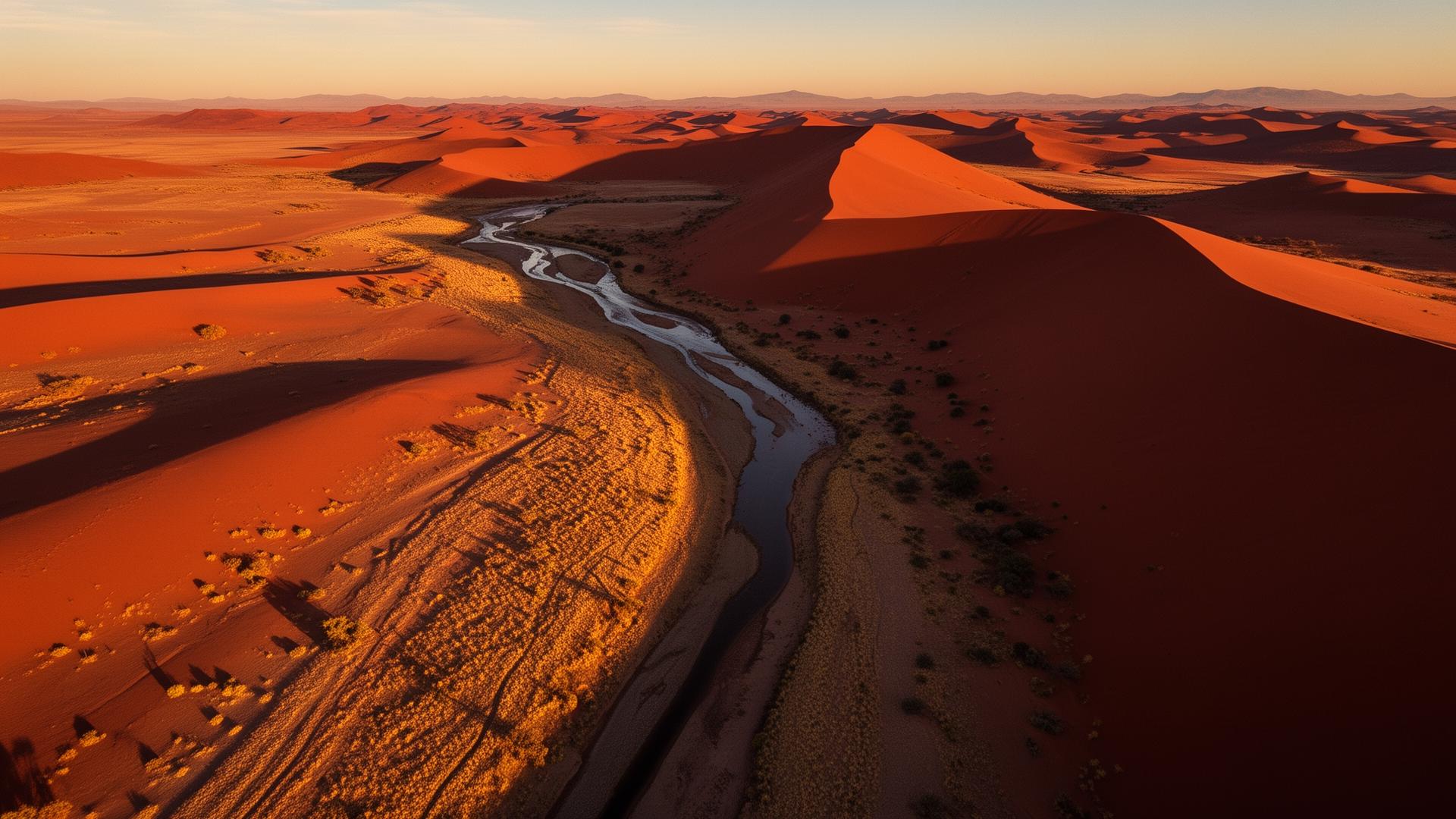

The usual question is: do we need a 4x4 for Namibia? The more useful question is: what kind of trip are we trying to have? The car choice affects more than where you can go — it affects comfort, stress, pace, and how the trip still feels after a week of gravel. There is also a part of this question almost no rental brochure spells out clearly: which damage you are actually liable for once you leave the tar.
On this page7Start with the route, not the dream car · When a 2WD can be enough …
Start with the route, not the dream car
Many travellers start by thinking about the coolest-looking car. That is backwards. The route should decide the vehicle.
Namibia has tar roads (the B-routes and a handful of major C-routes), graded gravel roads (most C-routes), rougher district roads (the D-numbered network), sandy sections in the Kaokoveld and parts of Damaraland, long lodge access roads that the map quietly forgets, and a wet season that can turn the same route into a different driving day altogether.
Match the car to the worst day of your route, not the average. The car you regret is the one that was fine for ninety per cent of the trip but became a problem on the one road you actually drove to see.
Quick check
Is this you?
When a 2WD can be enough
If you are sticking to a classic route, travelling in the drier season (May to October), sleeping in lodges, and staying on mainstream B and C roads, a 2WD can work perfectly well. Plenty of travellers do Namibia this way and have a great trip.
The mistake is assuming that because it is possible, it is automatically the best choice. A 2WD works best when the route is genuinely conservative — no improvised detours, no casually-added D-road shortcuts, no rainy-season optimism. The moment your plan includes Spitzkoppe, the Skeleton Coast access roads, or anything in the Kaokoveld, the calculation changes.
- classic lodge-based route
- mostly mainstream tourist roads
- dry conditions
- travellers who are happy to skip rougher detours
Read this next
Car choice, route shape, and day length are tied together.
Choosing the right vehicle only helps if the route and driving days are realistic too, not just technically possible.
When a 4x4 earns its price
A 4x4 earns its price for reasons most rental sites underplay. The diff lock is rarely the point. The two spare wheels, the dual fuel tank, the higher clearance over rocks and mid-road erosion ridges, and the more forgiving suspension on washboard — those are what change the trip.
On a long gravel day, a sedan punishes you. By hour four your shoulders are tight, the cabin is louder, and every washboard section forces you to slow more than you would in a Hilux. That cumulative tiredness is what people mean when they say a 4x4 'felt safer' — it is not the traction, it is the suspension and the seating position letting you drive at the same realistic 80 km/h all day without arriving destroyed.
The harder cases: rainy-season travel, anywhere with sand, multi-day camping setups, the Kaokoveld, and any route where a single closed road would force a 200 km detour. In all of these, a 4x4 is not luxury — it is risk reduction.
- rougher D-roads or remoter lodges (Damaraland, Kaokoveld, parts of the south)
- rainy-season travel (Jan–Apr), where one bad crossing changes the day
- camping-heavy routes — most camping setups are mounted on 4x4s for a reason
- any route with a long lodge access road (Sossusvlei, parts of Damaraland)
- travellers who want one less thing to worry about on long gravel days
Why gravel vs. tar changes the whole day
A long day on tar feels very different from a long day on gravel — and the difference compounds. On gravel you drive slower, stop more, and feel the road through the whole car. By the third gravel day in a row, even fit travellers notice it.
The numbers are simple. Tar in Namibia: realistic average 100 km/h. Graded C-road gravel: realistic 70–80 km/h, less when washboard sets in. Rougher D-roads: 50–60 km/h. A 350 km day that looks identical on the map is four hours on tar and almost six on gravel — and the gravel six hours leaves you a different kind of tired.
Road type matters more than distance when you plan the route. A short gravel day with a long lodge access road can be harder than a long tar day. Once that becomes clear, the car question gets much more practical.
The insurance trap nobody warns you about
Most rental cars in Namibia come with a standard CDW that leaves you exposed to a high excess (often N$30,000–N$80,000 depending on category). You can buy that excess down with a 'super cover' or 'zero excess' upgrade, and most travellers do.
What almost every package excludes — even the most expensive tiers — is tyres, wheels, rims, windscreens, underbody and water damage. These are the exact failure modes gravel actually causes. A windscreen crack from a stone is one of the most common claims in the country, and you pay for it directly. Two punctures on a long Damaraland day is normal, not exceptional, and the second tyre is almost always your cost.
Two practical responses: buy tyre and windscreen cover separately if your rental company offers it (some do, often N$80–N$150 per day, and it pays for itself on most trips), and never argue about the 80 km/h gravel ceiling. Above that, even covered damage tends to get reclassified as 'reckless driving' and the cover lapses.
The small things that matter more than people think
Even with the right car, Namibia still punishes poor preparation. Make the rental company show you how to change a wheel before you leave the lot — most Hilux setups carry the spare under the rear, and the jack point is not obvious. If you have not done it once on the forecourt, doing it for the first time on the C39 in 38°C is not a great moment.
Tyre pressure matters more than people expect. A normal Hilux runs around 2.0–2.2 bar on the road. Drop to roughly 1.6 bar on long gravel sections to reduce puncture risk and improve comfort, and to roughly 1.2 bar in genuine soft sand. Most rental companies will explain this; if yours does not, ask before you sign.
The smartest decision is rarely the most expensive car. It is the one that matches the real route, the real season, and the real people taking the trip.
- ask for two spare wheels on any route through Damaraland or the Kaokoveld
- deflate tyres on long gravel — it is the single biggest puncture-reducer
- do not assume every 4x4 is equally comfortable or capable (Hilux ≠ Duster)
- factor luggage, camping gear and passenger comfort into the decision
The questions we would actually ask you
Not just 'Do you need a 4x4?' but: where are you going, in what season, how confident are you behind the wheel, what kind of trip do you want, and how much rough driving or compromise are you actually comfortable with? Once those answers are clear, the vehicle choice usually becomes much easier.
That is the difference between generic internet advice and real trip planning. One tells you what is possible. The other helps you choose what actually makes sense for your trip.
Frequently asked questions
Can I do Sossusvlei and Etosha in a 2WD?
Yes, both are reachable in a normal sedan via tar and graded gravel — the C19 to Sesriem and the B1/C38 to Etosha are well maintained. The catch is the lodge access roads and any wet-season crossing. If you stay in lodges on the main road and travel May to October, a 2WD works. If you want to base at a remote lodge or you visit in summer, a 4x4 is the safer choice.
What speed should I actually drive on Namibian gravel?
80 km/h is the unofficial ceiling locals stick to and what most rental contracts quietly require. Above that, washboard and loose stones make the car float, braking distances double, and a single oncoming truck dust cloud can hide a pothole. Most serious single-vehicle accidents in Namibia involve gravel speeds above 100 km/h.
Are tyre and windscreen damage covered by my rental insurance?
Almost never, even on the highest 'super cover' tier. Tyres, wheels, rims, windscreens, underbody and water damage are the standard exclusions, and they are also the most common gravel failures. Many companies offer separate tyre and windscreen cover for around N$80–150 per day — on most Namibia trips, that small upgrade pays for itself.
Do I really need a roof tent and camping setup, or is a normal 4x4 enough?
Only if you genuinely want to camp. A camping-equipped 4x4 is heavier, slower, more expensive per day, and only saves money if you actually use the campsites instead of lodges. For a lodge-based trip, a budget 4x4 without camping gear is usually the best value — comfort of a 4x4, no setup overhead.
Final verdict
If you already have a route in mind, we can tell you whether your planned car actually fits the roads, the pace, and the kind of trip you want to have.
Need more than a car check?
If you are still deciding where to go, how much ground to cover, or what kind of trip makes sense for your budget and comfort level, we can also help plan the whole route with you.