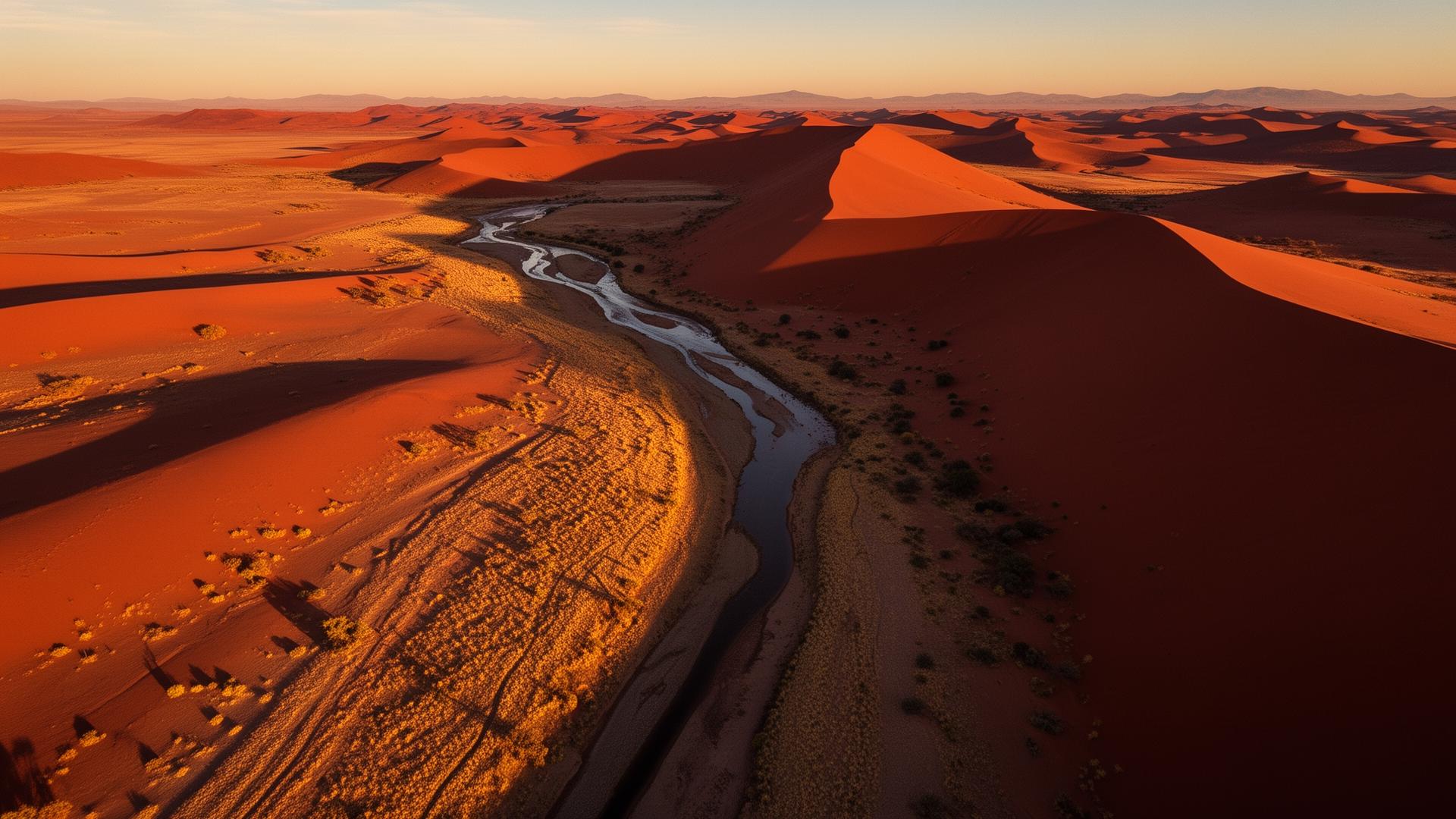

"Do I need a 4x4 in Namibia?" is the most-Googled question about Namibian self-driving, and almost every page that ranks for it is written by someone selling 4x4 rentals. The honest answer is that it depends on the route — and once you split the country into the routes people actually drive, the question collapses into something you can decide in five minutes. Here is what each common Namibia trip actually needs, where a 2WD with high clearance is genuinely fine, where 4x4 is non-negotiable, where the answer changes by season, and the parts of vehicle choice nobody on a rental page will tell you.
On this page9The short answer: three vehicle classes, three different trips · Routes where 2WD is genuinely fine …
- 1.The short answer: three vehicle classes, three different trips
- 2.Routes where 2WD is genuinely fine
- 3.Routes where 4x4 is non-negotiable
- 4.The grey zone: Etosha, Sossusvlei, Skeleton Coast
- 5.4x4 is not an off-road licence — the rules nobody mentions
- 6.Cost delta in 2026: what the 4x4 premium actually buys
- 7.Rooftop tent: when it earns its keep, when it is a tax on your sleep
- 8.Quick decision table by traveller profile
- 9.How we answer it for clients in one minute
The short answer: three vehicle classes, three different trips
Namibian rental fleets cluster into three real categories, regardless of how many model names a website lists. A 2WD sedan or small SUV with reasonable clearance (Toyota Corolla Cross, VW Polo Sedan, Hyundai Creta) handles tar and well-graded gravel and costs roughly N$900–1,400 per day. A 4x4 SUV or single/double-cab bakkie (Toyota Hilux, Ford Ranger, Toyota Fortuner) handles everything the 2WD does plus rough tracks, river crossings, and self-recovery, and costs roughly N$1,800–3,200 per day. A fully kitted 4x4 with rooftop tent, fridge, water tank, jerrycans, and camping gear (Bushlore, Asco, Britz, Caprivi, Savanna) is a self-contained desert-living rig and costs roughly N$2,500–4,500 per day.
The mistake first-timers make is choosing the dream rig instead of the right one. The mistake experienced travellers sometimes make is going the other way and trying to do Damaraland in a 2WD because the brochure said the gravel was "manageable." The route decides — not the marketing.
Quick check
Is this you?
Routes where 2WD is genuinely fine
If your trip is the standard 10–14 day classic loop in dry season — Windhoek, Sossusvlei, Swakopmund, Etosha, back via Waterberg or Okonjima — and you are sleeping in lodges every night, a 2WD with high clearance is honestly fine. The B1, B2, and main C-roads (C19, C26, C28, C36 to Sesriem) are well graded, and the lodge access roads on this corridor are short. Hundreds of travellers do this loop every month in 2WDs without incident, and the people telling you otherwise are usually selling something.
The 5-day Cape Town stopover route, the southern loop in dry season, and any trip built around Swakopmund as a base are also 2WD-territory. So is a Windhoek-Sossusvlei-Windhoek triangle, even with a side trip to NamibRand. The savings are not trivial — over two weeks, the difference between a 2WD and a fully kitted 4x4 is often more than a domestic flight, sometimes two.
- Classic loop in dry season (May–October), lodges only — 2WD high-clearance works.
- Cape Town to Sossusvlei stopover via Fish River — 2WD fine, no off-camber tracks.
- Swakopmund-based week with day trips to Walvis, Sandwich Harbour (booked tour), Spitzkoppe day visit — 2WD fine for the base, the operator handles the dunes.
- Southern loop (Fish River Canyon, Lüderitz, Aus, Sossusvlei) in dry season — 2WD with high clearance handles all of it on graded gravel.
Routes where 4x4 is non-negotiable
There are corners of Namibia where renting a 2WD is not a saving — it is the trip ending in a recovery bill. Anything in the Kaokoveld (Van Zyl's Pass, Marienfluss, Hartmann's Valley, the route to Epupa via Otjihaa rather than via Opuwo) needs proper 4x4 with low range, two spare wheels, and someone in the car who has done it before. Damaraland tracks beyond Twyfelfontein — the proper desert-elephant tracking corridors, Doro !Nawas, Palmwag concession internal tracks — are 4x4 only.
The deep south past Aus toward Lüderitz is fine on tar, but the Hardap–Mariental–NamibRand interior tracks and the river crossings into the Naukluft are 4x4. So is anything in the Caprivi off the B8 — Bwabwata internal tracks, Mudumu access roads, and the Linyanti corridor. And in the green season (mid-December through early April), the Sesriem access road, the C39 through Damaraland, and the gravel into the Kunene region all sit in the 4x4 column whether they normally would or not, because rivers run, surfaces wash, and recoveries take a long time when the only vehicle that comes past in two hours is also stuck.
If your route includes any of the above, the 4x4 is not a comfort upgrade — it is the price of admission. Trying to do these on a 2WD is not adventurous. It is the cause of most of the rental-recovery stories you read on travel forums.
The grey zone: Etosha, Sossusvlei, Skeleton Coast
These three are the routes where the answer genuinely depends on details people often skip. Etosha itself — the internal park roads — is 2WD-friendly almost everywhere except after heavy rain. The grey zone is the access. If you are sleeping inside the park (Okaukuejo, Halali, Namutoni), a 2WD is fine year-round. If you are sleeping at Onguma, Mushara, Etosha Heights, Ongava, or any of the private reserves on the south or east boundary, the access roads vary — most are short and graded, a few are washboard tracks that punish a sedan. Confirm with the lodge specifically which access road they use, and what they recommend.
Sossusvlei has the same split. The main access from the C19 to Sesriem is paved. From Sesriem to the 2x2 parking area inside the park is paved. The last 5 km from the 2x2 to the Sossusvlei parking is deep sand and 4x4 only — but the park runs a shuttle, so a 2WD trip just parks and uses the shuttle. The change is when your lodge sits on the gravel feeders south of Sesriem (parts of the C27, the access into NamibRand) — those tracks bite. And in the green season, the Sesriem access road itself can be cut by river floods, which is its own article.
Skeleton Coast C34 — Swakopmund to Henties to the salt road north — is technically 2WD passable in dry weather, but the salt surface punishes brakes and tyres, and the wind-blown sand near Cape Cross can make a low-clearance car uncomfortable. North of Terrace Bay it becomes a permit-only 4x4 area. So: south of Henties, fine in 2WD; Henties to Terrace Bay, prefer 4x4 if you have it; north of Terrace Bay, 4x4 with guide and permit only.
4x4 is not an off-road licence — the rules nobody mentions
The most expensive Namibian rental claims do not come from people in 2WDs trying to do hard tracks. They come from people in 4x4s who treated the 4x4 as permission to drive faster. The 80 km/h gravel speed limit applies to every vehicle. The windscreen-and-tyre insurance exclusion applies to every vehicle. The after-dark driving exclusion applies to every vehicle. A 4x4 just means you can survive a worse surface — not that the surface stops being dangerous.
The other thing rental sites bury is the standard insurance excess on 4x4 vehicles. The base insurance on a fully kitted Hilux often carries an excess of N$30,000–60,000, with separate exclusions for tyres, rims, windscreen, underbody, and rolling. Roll a 4x4 on a gravel curve at 110 km/h and the rental company classifies the claim as reckless driving, which voids the cover entirely. The 4x4 is genuinely safer at the surfaces that need it. It is genuinely more dangerous when treated as an excuse to drive like the road is tar.
Cost delta in 2026: what the 4x4 premium actually buys
On a 14-day trip, the difference between a small 2WD and a single-cab 4x4 is roughly N$12,000–25,000 in 2026. The difference between a 2WD and a fully kitted rooftop-tent 4x4 with all the camping gear is N$25,000–45,000 — sometimes more in peak season. That is not nothing. Spent on the right trip it disappears into the experience; spent on a trip that did not need it, it is the cost of a lodge upgrade you never got.
The honest framing: pay for the 4x4 the moment your route includes a section that needs one. Do not pay for it because the rental site implied your trip would be safer with one. Most insurance claims data we see suggests the safer car for a classic dry-season loop is whichever one the driver is most comfortable in — and for many first-time visitors, that is the smaller, lighter, more familiar 2WD, not a high-centre-of-gravity bakkie they have never driven before.
Rooftop tent: when it earns its keep, when it is a tax on your sleep
Rooftop tents are romantic until the third night, when you realise that pitching and striking the tent every morning, climbing a ladder in the dark to pee, sleeping above the engine when the dew is heavy, and carrying everything up and down a metal ladder is genuinely tiring. They earn their keep on a camping-first trip with long stays at each site (3+ nights), or in remote areas where there is no other accommodation option — Spitzkoppe community camps, Kaokoveld bush camps, parts of the Kunene.
They are a tax on your sleep when the trip is mostly lodges with one or two camping nights bolted on. In that case, take the 4x4 without the rooftop and save 30–40% on the rental, sleep in the lodges as planned, and use a swag or ground tent for the one or two camping nights if you really want them. The rooftop also raises the vehicle profile enough to matter on the few low-bridge accesses around Sesriem and at some lodge gates.
Quick decision table by traveller profile
After several hundred reviews, the pattern is consistent enough to summarise. Use this as a starting point — your specific route can shift the answer either way, and that is exactly what a route review is for.
- First-timer, 10–14 day classic loop, dry season, lodges only — 2WD high-clearance is fine. Save the money for a second night at Etosha.
- First-timer, same route, but green season (Dec–April) — 4x4. Sesriem access and the C39 can flood.
- Family with kids, classic loop, lodges — 2WD or small SUV. Easier to park, easier to load, easier kids in and out.
- Honeymoon, premium loop with private concessions — let the operator transfer you between concessions; rent the smallest car that gets you between them. Often a 2WD is enough.
- Photographer, slow-desert route with NamibRand and Damaraland — 4x4. Off-camber tracks, dawn departures on broken surfaces.
- Experienced driver, 18-day off-loop with Kaokoland — 4x4 with low range, two spares, fridge, recovery kit. Non-negotiable.
- Solo or solo-female, classic loop on lodges in dry season — 2WD high-clearance is fine; pick a model you have driven before. Familiarity beats capability when you are alone.
- Camping-first trip, any season — 4x4 with rooftop tent earns its price; this is the trip the kit was designed for.
How we answer it for clients in one minute
The shortcut we use when reviewing a draft: list every drive segment in the route, mark each as paved / good gravel / rough gravel / track-only, and check the season. If every segment is paved or good gravel and the season is dry, the answer is 2WD. If even one segment is rough gravel, track-only, or in green season, the answer is 4x4. The grey zone is whether the 4x4 needs to be a fully kitted camping rig or a stripped SUV — that is decided by where you sleep, not how you drive.
Most weak first-time itineraries have either over-rented (kitted 4x4 for a lodge loop they never camp on) or under-rented (2WD for a route with one segment that needed a 4x4). Both are recoverable before booking. Both are expensive after.
Frequently asked questions
Do I need a 4x4 to drive to Sossusvlei?
Not to reach Sesriem, and not to reach the 2x2 parking inside the park — both are 2WD-friendly. The last 5 km from the 2x2 to Sossusvlei is deep sand and 4x4 only, but the park runs a shuttle, so a 2WD trip parks and rides the shuttle. In the green season (Dec–April), the access road from the C19 to Sesriem can flood, which can shift the answer.
Can I drive in Etosha with a 2WD?
Yes. The internal Etosha park roads are graded gravel and 2WD-friendly almost year-round. The grey zone is your lodge access road if you are sleeping outside the park boundary — confirm with the specific lodge what road they use and what they recommend.
Is the difference in cost worth it for a 4x4?
On a 14-day trip, the cost gap is roughly N$12,000–25,000 between a 2WD and a basic 4x4, and N$25,000–45,000 for a fully kitted rooftop-tent 4x4. Worth it the moment your route includes Damaraland, Kaokoveld, river crossings, or any green-season travel. Wasted if your route is a dry-season classic loop on tar and main C-roads with lodge accommodation throughout.
Will my insurance cover gravel-road damage?
Mostly not. Tyres, windscreens, rims, and underbody damage are excluded from almost every standard insurance package — including most "super cover" tiers — and these are the exact failure modes gravel causes. Buy separate tyre and windscreen cover if it is offered, and never exceed the 80 km/h gravel speed limit, because faster claims get reclassified as reckless driving and the cover voids.
Should I take the rooftop tent option?
Only if your trip is camping-first with long stays at each site. For trips that are mostly lodges with one or two camping nights, skip the rooftop, save 30–40% on the rental, and use a ground tent or swag for the camping nights. The rooftop sounds romantic and gets old quickly when you are striking it every morning.
Final verdict
There is no universal right car for Namibia — there is only the right car for your specific route in your specific season. If you are about to book, send us the route first. The vehicle question is often the cheapest fix in a Namibia plan, and the most expensive one to get wrong.

Kian, Inside Namibia· Based in Swakopmund · desert specialist
I live in Swakopmund and spend most of my time in the desert — I know its dunes, its silences, and most of the snakes you'd rather not meet. My favourite stretches are the loneliness of Damaraland and the birding in Caprivi, and that's the lens I bring to every route I review.
Have us read your Namibia plan before you book the car
Send us your route and we will tell you exactly which vehicle class fits, where the grey zones are, and where you can save without compromising the trip. Most reviews come back the same week.